
Instrumentation Installation.png

Installation & Commissioning

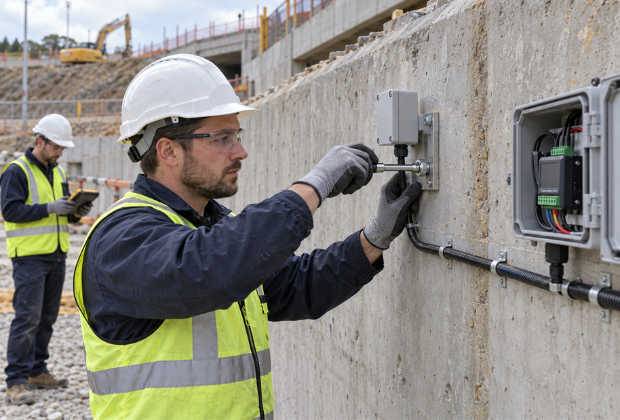
Sensor choice is only one part of reliable monitoring. Installation method, protection, cable routing, identification and baseline readings all decide whether a system delivers dependable data. GEL Instrumentation handles these as one scope so gaps close before monitoring begins.

Commissioning then proves the system works. We verify instrument response, channels, communications and data flow, and capture the baselines that later readings are measured against. Your team receives a checked system with full installation and commissioning records at handover.

What This Covers

  • Pre-installation planning: Sequencing against the construction program, access, permits and site coordination.

  • Instrumentation installation: Placement, installation method, protection, cable routing and identification.

  • Logger, enclosure and power works: Logger and interface installation, enclosures, cabling, solar and battery.

  • Commissioning and handover: Channel checks, communications testing, baseline readings and handover records.

Key Benefits

  • Experienced installers across mining and civil projects

  • Quality assurance testing and field verification

  • Commissioning reports with baseline readings

  • Training and handover for your site personnel

Why Choose GEL?

One Connected Team.svg

One Connected Team

GEL Instrumentation coordinates supply, installation, integration, monitoring and software through one technical team, reducing supplier handoffs.

Technology Matched to the Project.svg

Technology Matched to the Project

Technology selected around the measurement objective and the site constraints, rather than forcing one product onto every problem.

Complete Solutions From Design to Data.svg

Complete Solutions: Design to Data

System design, supply, installation, commissioning, monitoring, data and ongoing support, handled by one team from end to end.

30+ Years of Monitoring Experience.svg

30+ Years of Monitoring Experience

Since 1993, supporting geotechnical and infrastructure monitoring projects across Australia.

Frequently Asked Questions

  • What is the difference between installation and commissioning?
    Installation puts the instruments in the ground or on the structure; commissioning proves that the whole system actually works. Commissioning checks instrument response, channel assignment, communications and data flow through to the platform, and captures the baseline readings that later measurements are compared against. An instrument can be installed correctly and still not be reporting, which is what commissioning catches.
  • Baseline readings matter because every later measurement is interpreted against them. Without a known starting point you can see that a value has changed, but not by how much relative to the undisturbed condition. GEL Instrumentation establishes baselines during commissioning and records them in the handover documentation, so the reference stays with the asset rather than with one person's spreadsheet.
  • Yes, and it is routine. Installation is sequenced against the production or construction program so each position is completed inside an available access window. This requires planning the drilling, installation, protection and make good as one block of work rather than separate visits, and coordinating directly with the site team holding the schedule.
  • You receive installation records covering what was installed and where, commissioning records showing the checks performed, and the baseline readings for every channel. Together these give the project team a documented account of the system's condition at handover, which is useful both for the team completing the works and for whoever manages the asset afterwards.
  • Yes, where the instruments are compatible with the monitoring system and the installation method is suitable for the site. We review what has been supplied, confirm how it connects to the acquisition and communications layers, and install and commission accordingly. Instruments from several sources can usually be brought into one monitoring workflow.

Plan Your Installation Around the Project

Tell us the instrument schedule, the site and the program. Our engineers will plan the installation and commissioning around your construction sequence.